Ethical AI in Education: A Policy and Implementation Guide
By EduGears AI Team
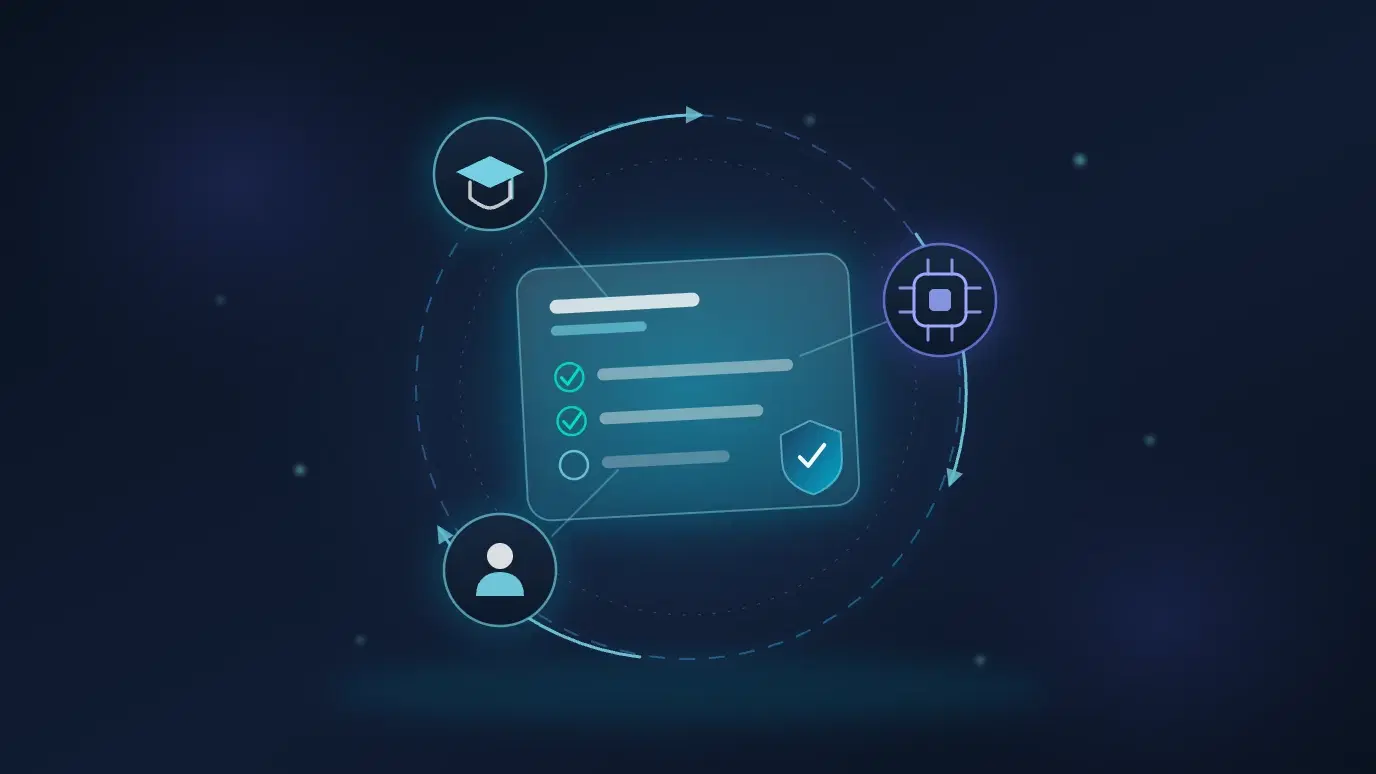
A workable institutional AI policy answers five questions: where AI may and may not be used in assessed work, how learner data is handled and by whom, who remains accountable for decisions that AI influences, what training staff and students receive before they touch the tools, and how often the policy is reviewed. Everything else — approved tool lists, prompt guides, detection software — is downstream of those five answers. This guide walks through the risk areas an education AI policy has to address, a five-stage implementation framework, and the questions worth asking any vendor before a contract is signed.
The order matters more than most institutions expect. AI adoption in schools and universities almost never begins with a procurement decision; it begins with individual staff quietly using consumer tools on work they already had to do. By the time a committee convenes, there is usually a year of undocumented practice to reckon with, and the policy is written as a retrofit rather than a framework. Writing the policy first does not slow adoption down — it is the thing that lets an institution say yes to a tool quickly, because the criteria already exist.
The regulatory ground has also firmed up considerably. The U.S. Department of Education's Office of Educational Technology published 'Artificial Intelligence and the Future of Teaching and Learning: Insights and Recommendations' in May 2023, drawing on listening sessions with more than 700 educational stakeholders, and followed it in July 2024 with 'Designing for Education with Artificial Intelligence: An Essential Guide for Developers.' UNESCO issued its 'Guidance for generative AI in education and research' in September 2023, the first global guidance of its kind. As of 2026, more than thirty U.S. states have published AI guidance for K-12 schools, and Ohio has gone furthest: its Department of Education and Workforce released a model AI policy in late 2025, and every public, community, and STEM school there was required to adopt an AI policy — the state template or a local equivalent — by July 1, 2026. Institutions writing a policy today are no longer improvising from scratch.
Academic integrity is the risk area every committee starts with, and the one where policy language does the most work. A blanket ban is unenforceable and a blanket permission is indefensible, so the durable pattern is course-level disclosure: each syllabus states which uses of AI are permitted for that assessment, and students declare what they used. That shifts the burden from detection — which carries a real false-positive cost and falls unevenly on multilingual writers — to assessment design and honest declaration. Institutions that get this right tend to redesign a handful of high-stakes assessments rather than police all of them.
Data privacy is where policies most often fail a diligence review. In the United States, the Family Educational Rights and Privacy Act governs education records and the Children's Online Privacy Protection Act governs personal information collected from children under 13; in Europe, the GDPR applies in full. The practical question is not whether a vendor claims compliance but what actually leaves the institution: which fields are sent to an AI provider, whether that provider is a named subprocessor, whether prompts or submissions are retained, and whether a data processing agreement is available in writing. UNESCO's guidance recommends that governments consider a minimum age of 13 for students' independent conversations with generative AI platforms, which is a useful default for any K-12 policy even outside its jurisdiction.
Bias and fairness deserve their own section rather than a sentence, particularly wherever AI touches assessment. The European Union's AI Act classifies several education uses as high-risk in Annex III: AI systems used to determine access or admission to institutions, to evaluate learning outcomes, to assess the level of education a person will receive, and to monitor for prohibited behaviour during tests. That last category covers automated proctoring, which has drawn sustained criticism for uneven false-positive rates across skin tones, disabilities, and home environments. The AI Act's AI-literacy obligation under Article 4 — which requires providers and deployers to ensure staff using AI systems have a sufficient level of AI literacy — has applied since February 2025, with the high-risk obligations phasing in behind it. Even institutions outside the EU are finding Annex III a useful map of where scrutiny should concentrate.
Over-reliance is the slowest risk to appear and the hardest to reverse. When AI drafts the lesson, generates the questions, and proposes the grades, the professional judgment that used to be exercised at each of those steps can quietly atrophy — in staff and in students alike. The Department of Education's report frames the alternative memorably: it argues for a future more like an electric bike, where the human stays fully aware and in control while their effort is multiplied, and less like a robot vacuum that operates without oversight. A policy can encode this by naming the decisions that must never be fully automated, rather than by trying to cap how much AI anyone uses.
Transparency to students is the risk area most often left out, and it is the one most likely to generate a complaint. If AI contributed to a grade, a placement, or a flag on someone's academic record, the student should be told that it did, told in general terms how, and given a route to a human review. The Department of Education's report leans on the same principle drawn from the Blueprint for an AI Bill of Rights: people should have access to timely human consideration and a fallback process when an automated system errs or when they wish to contest its impact. Publishing the appeal route alongside the policy costs nothing and defuses most disputes before they escalate.
With the risk areas mapped, implementation is best run in five stages: pilot, policy, training, rollout, review. The pilot comes first deliberately. A small, bounded trial — one department, one term, a named faculty lead, and a written question the pilot is meant to answer — produces evidence that a policy can be written against, instead of a policy written against a vendor's marketing. Pilots should be sized so they can fail without institutional consequence, which usually means a few courses rather than a faculty.
The policy stage turns pilot findings into rules. A usable AI policy is short and specific: permitted and prohibited uses by role, the data categories that may and may not be sent to AI systems, the approval route for adding a new tool, the decisions that require a human of record, disclosure expectations for staff and students, and the named owner of the policy. Governance belongs here too — the Ohio model policy's structure is instructive, pairing AI literacy and data protection with a standing workgroup of educators, administrators, students, and community members that reviews new guidance as it appears.
Training is the stage institutions most often shorten and most often regret. Under the EU AI Act, AI literacy for staff operating AI systems is now a legal obligation rather than a nice-to-have, and even where it is not, an untrained user is the single largest source of policy violations. Effective training is role-specific: faculty need to know how to review AI-generated content and where the model is likely to be confidently wrong; administrators need to know the escalation path; students need to know what disclosure means for them. An hour that shows staff a real failure case does more than a day of principles.
Rollout should widen along the lines the pilot validated, with the metrics agreed in advance — time saved, feedback turnaround, learner outcomes, complaint volume — and with the ability to switch a feature off without switching the platform off. Review then closes the loop. AI capabilities and the regulations around them are both moving faster than an annual governance cycle, so the sensible cadence is a scheduled review each term or semester, with a standing trigger for an out-of-cycle review whenever a vendor materially changes how a feature works.
Across all five stages, one commitment should be treated as non-negotiable: human-in-the-loop grading. Human-in-the-loop grading means an AI system may propose a score and draft feedback, but a qualified educator reviews it, can change it, and is accountable for the grade that is finally recorded. This is the first and central recommendation of the U.S. Department of Education's report — 'Emphasize Humans in the Loop' — and it aligns with the EU AI Act's treatment of learning-outcome evaluation as high-risk. It is also the commitment that makes every other part of an AI policy defensible, because it keeps a person answerable for every consequential decision.
That commitment gives an institution a sharp set of questions to put to any vendor. Where is our data processed, who are your subprocessors, and is a data processing agreement available? Can we bring our own AI provider keys, so AI usage runs under our own account and our own terms? Can an educator see, edit, and override every AI-generated score before it is recorded, and is that the default rather than a setting? What does your AI know about our curriculum when it generates — is output grounded in our uploaded materials and standards, or in the open internet? Is customer content ever used to train models? And can we export our courses, grades, and credentials in open formats if we leave? The Department of Education's 2024 developer guide organizes the same territory into five expectations of vendors — designing for teaching and learning, providing evidence of rationale and impact, advancing equity and protecting civil rights, ensuring safety and security, and promoting transparency — which makes a serviceable scoring rubric for a vendor shortlist.
We built EduGears AI to answer those questions in the affirmative, because they are the questions our own customers' committees ask. Grading is assistive: AI applies the rubric an instructor defined, and instructors retain the ability to override AI-generated scores. Generation is curriculum-grounded, drawing on the syllabus and materials an institution uploads rather than the open web, so output stays inside the scope that was actually taught. On privacy, institutions can bring their own AI provider keys, choose among multiple AI providers, and rely on a hard rule that customer content is never used to train models; learner data in our LMS is isolated at the database layer with row-level security, submissions processed for AI grading are purged the same day, and we operate as a FERPA school official for U.S. institutions with COPPA-appropriate handling for younger learners and a DPA available for institutional partners. And because we build on LTI 1.3, SCORM, Common Cartridge, and Open Badges 3.0, the exit question has a real answer.
The staging works the same way in practice. Our Moodle and Canvas integration starts free on every platform, so a single faculty member can run the pilot stage inside one course before an institution commits to anything — which is exactly the order this framework recommends. If your committee is drafting a policy now, take the five questions at the top of this piece, answer them for your own institution, and use the answers as the specification you hand to vendors. The institutions moving fastest on AI in 2026 are not the ones with the loosest rules; they are the ones whose rules were clear enough to make a decision quickly.