The New U.S. Rules for AI in Schools: What They Mean, and How to Stay Compliant
By EduGears AI Team
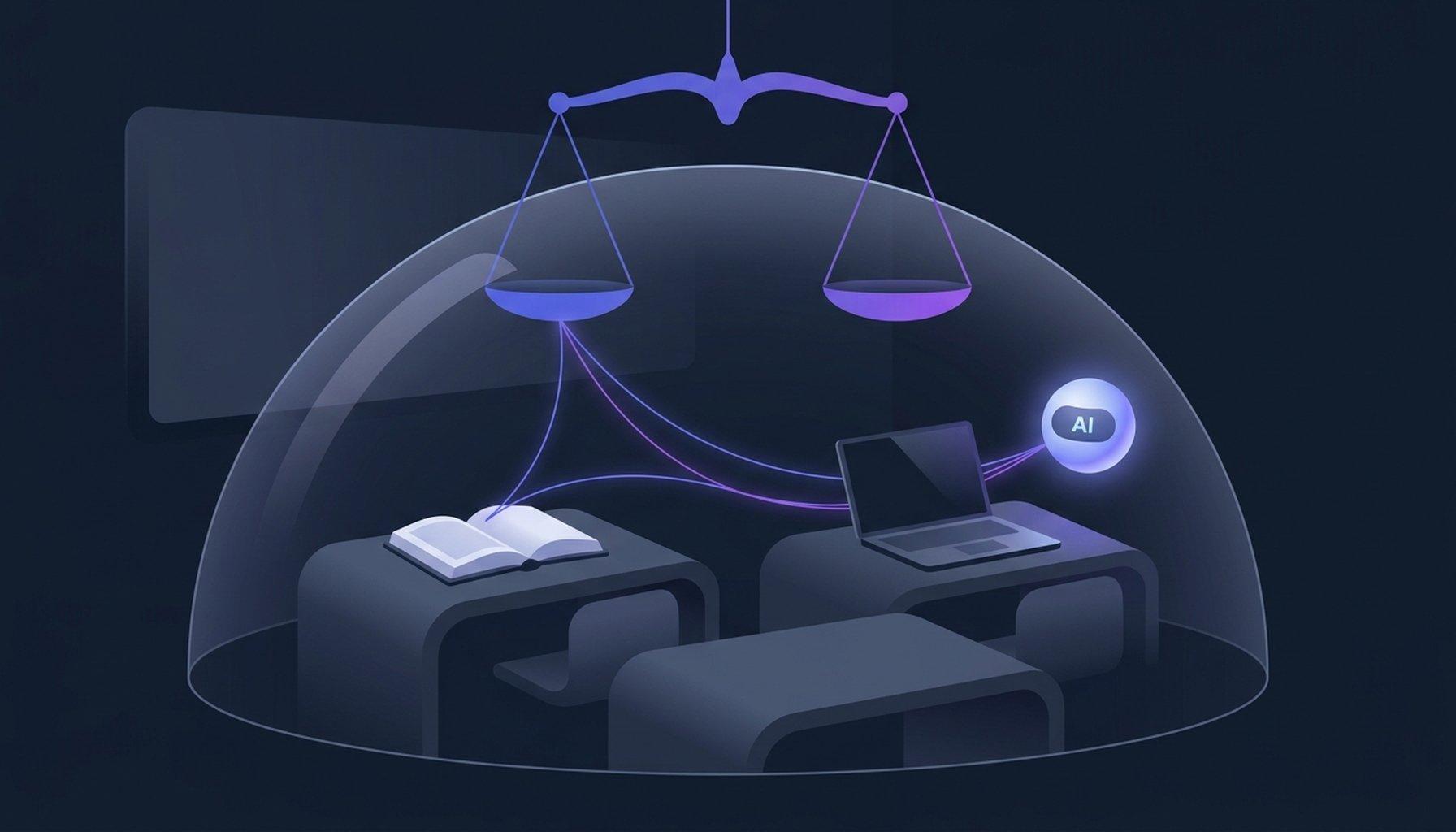
For two years the debate about artificial intelligence in education was mostly a debate about opinion. In the space of about a year, it has become a debate about rules. In July 2025 the U.S. Department of Education issued a Dear Colleague Letter, signed by Secretary Linda McMahon, confirming that federal grant funds can be used for AI in schools and colleges. Then, through 2026, states began converting the letter's principles into binding requirements. If you lead a school, a district, or a college, the practical question is no longer whether to have a view on AI. It is whether the AI you adopt satisfies a federal permission and a growing stack of state conditions at the same time. This is a plain-language guide to both — and to how the EduGears AI family of products is built to meet them.
Start with the permission, because it is genuinely good news. The Dear Colleague Letter says that both formula and discretionary federal grant funds — the same money that already flows through programs like Title I-A, Title II-A, Title IV-A, and Perkins CTE — can pay for AI, provided the use is allowable under the program the money comes from. The Department names three kinds of use in particular: high-quality instructional materials, high-impact tutoring, and college and career pathway advising, including help with course selection and financial-aid navigation. Crucially, the funds can pay not only for the tools but for training the educators, providers, and families who use them. For the first time, a district can point existing federal dollars at a well-chosen AI platform without inventing a new budget to do it.
The permission comes with a conscience. The same letter sets out five principles for what responsible AI in a school should look like, and they are worth committing to memory because they are the lens every grant officer and, increasingly, every state will use. AI should be educator-centered — it supports teachers and leaders rather than replacing them, and a human stays responsible for instruction and grades. It should be ethical — students learn to evaluate AI output and use it with integrity, not to outsource their thinking. It should be accessible — the tools work for learners and educators with disabilities. It should be transparent — parents and stakeholders understand how a system works and have a voice in adopting it. And it should protect privacy — the tools comply with federal privacy law, including FERPA. In April 2026 the Department went further, finalizing a grant-priority rule that gives extra weight to proposals advancing AI literacy and the ethical use of AI, so a serious tool is now a scoring advantage on a competitive application, not merely a permitted purchase.
If the federal letter says should, the states are starting to say must. More than thirty-five states now publish official AI guidance for schools, and several have moved from guidance to regulation. In September 2026 the Florida Board of Education approved rules for K-12 districts and state colleges that read like a procurement checklist: districts must notify parents when a child will use an AI product, must train teachers and administrators on AI's risks and limits, must not allow students to use AI unsupervised, must prioritize vendors that keep student data within the United States, and must not use vendors that sell, monetize, profile, or use student data to train commercial AI models. State colleges, for their part, must set their own limits on AI use. Whatever state you are in, treat that list as an early warning system. The specifics will vary, but the direction — parental transparency, staff training, data residency, and a hard line against commercial exploitation of student data — is unmistakable.
Put the two together and a buyer's job becomes concrete. A federally funded AI purchase now has to clear two bars. It has to be allowable — the use must genuinely serve the purpose of the grant it is paid from. And it has to be compliant — the tool must satisfy FERPA and the tightening state rules on data. The tools that will age well are the ones that were designed for those constraints from the start, rather than consumer AI products retrofitted with an education skin. The tell is in the answers a vendor can give quickly: where student data lives, whether it is ever used to train models, who stays responsible for grades, which accessibility standard the product meets, and whether the AI behaves itself during an assessment.
This is the ground the EduGears AI family was built on, so our answers are short. Across our white-label LMS, our LTI tool for Moodle and Canvas, and our authoring studio, the AI is grounded in your own course materials rather than in a data lake it builds about your students. Student data is hosted in the United States, which means the data-residency rule that states like Florida now impose is met by default. We do not use student data to train commercial models, and bring-your-own-key lets an institution run AI generation on its own account, keeping the data path under its control. Grading and rubric generation produce drafts a teacher reviews and can override — the educator, not the model, decides the grade. Every AI request is logged and reportable, answers cite their sources, and administrators set fair-use limits and can rename or scope the assistant. Learner-facing and assessment surfaces are built to WCAG 2.1 AA. And the assistant is careful around graded work: it withholds quiz answers during an attempt and opens up only after a student has submitted, so it can be left on without becoming a cheat sheet.
Notice how directly those design choices line up with the five federal principles and the emerging state rules. Educator-centered maps to grading that a human owns. Ethical maps to an assistant that teaches toward understanding instead of handing over answers. Accessible maps to WCAG 2.1 AA. Transparent maps to per-request reporting and cited sources. Privacy-protecting maps to U.S. hosting, no training on student data, and a signed data processing agreement in which we act as a school official under FERPA. This is not a coincidence of marketing; it is what happens when a platform is designed for schools rather than adapted to them.
The honest advice for a school or college leader right now is to move deliberately, not fearfully. The federal government has told you that you can fund AI. A rising number of states are telling you how it has to behave. Between those two statements is a real opportunity: to use money you already receive to give students better tutoring, teachers less drudgery, and counselors more time — with a tool whose privacy and accessibility posture you can defend to a parent, an auditor, and a school board without flinching. That is the bar we built the EduGears AI products to clear. If you are weighing a purchase against the new guidelines, bring them to us line by line; we would rather answer the hard questions on a live tenant than in a brochure.